
OnlyFans ranking sites usually show a single current price, which hides the story behind it. This article explains how to read the historical price data on BestOnlyFans ranking cards so you can judge whether a subscription is stable, promotional, or about to change.
Price history matters because subscription costs on the platform are not fixed. A creator can run at $4.99 for a year, then move to $9.99 without any visible notice in a feed. The ranking card is often the only place where that movement is recorded in one place.
Below you will find how the data is collected, what the patterns mean, and how to use alerts and renewal timing to keep your spending predictable.

BestOnlyFans Price History Methodology
Price history is only useful if the underlying numbers are collected in a consistent way. A ranking card that mixes verified figures with unverified guesses is worse than no history at all, because it creates false confidence.
The collection process behind these cards combines three inputs. Each input has a different reliability level, and the timestamps show which one produced a given entry.
| Data Source | Verification Method | Update Frequency |
|---|---|---|
| Automated page checks | Script reads the public subscription tier and records the value with a timestamp | Daily to weekly, depending on page volume |
| User-submitted reports | Cross-checked against at least one prior observation before publishing | Reviewed within a few days of submission |
| Creator submissions | Matched against the live page before the entry is marked verified | On request, then confirmed manually |
Timestamps are the key detail. A price entry without a date tells you nothing about whether the figure is a week old or a year old.
In practice, the methodology used for these ranking cards follows a simple rule: record the value, record the date, and label how it was confirmed. That structure is what makes the mid-article comparisons possible and what lets you trust a flat line rather than merely hope for one.
Reading Stability Signals in Historical Data
A flat price line is the strongest signal a ranking card can show. It means the creator has kept the same base rate across every recorded check, which usually reflects a settled audience and a business that does not need to test the market.
- Six or more months with no recorded change.
- Gradual single increases rather than sudden spikes.
- Consistent promotional cycles at the same points each year.
- Pricing that sits within the normal range for the category.
- Long creator tenure paired with a stable rate.
Volatile patterns tell a different story. A creator who moves between $4.99, $7.99, and $12.99 within a year is usually testing demand, reacting to churn, or running frequent campaigns. None of that is dishonest, but it does make budgeting harder.
For your own planning, stability is easier to work with. A predictable $9.99 that never moves is simpler to budget for than a $5.99 that becomes $14.99 two months after you subscribe.
This is also where ranking history beats a screenshot. A screenshot shows one moment. A history shows whether that moment is typical.
Detecting Promotional Pricing Cycles
Promotions and permanent changes look similar on a single card but very different across a timeline. The difference is repetition and duration.
Promotional first months can legally sit below $4.99, commonly around $3 for the first month. Base prices cannot. That single rule separates most discounts from genuine price moves.
- A first-month rate below $4.99 that reverts to a standard tier.
- The same discount reappearing at identical intervals.
- Seasonal timing, such as the start of a year or a holiday period.
- Explicit promotional labeling on the page during the offer window.
When you see the same $3 first month appear three times in eighteen months, treat it as a marketing rhythm rather than a price cut. The real cost to you is the standard tier that follows.
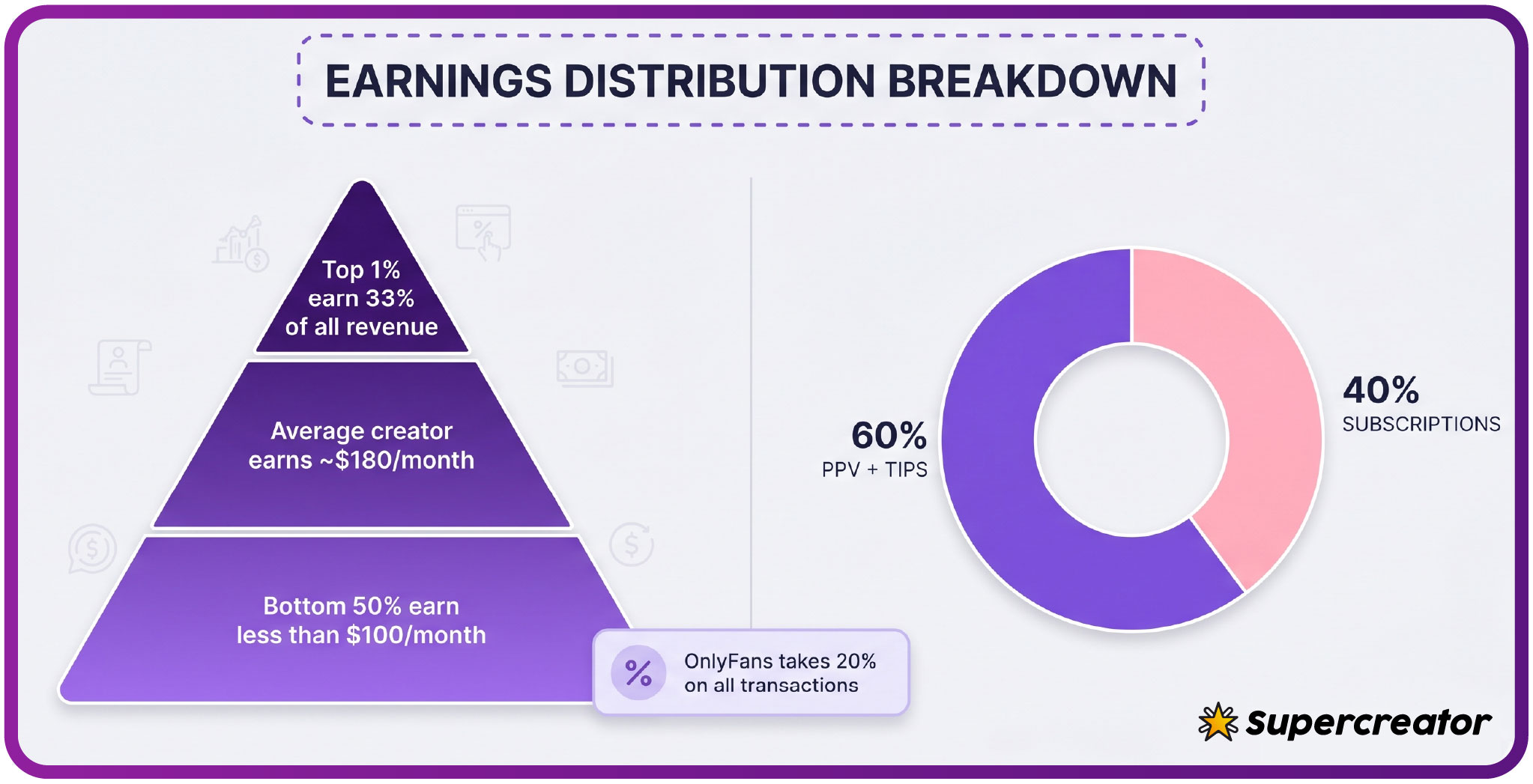
The 20% platform fee applies to everything, and the creator keeps 80%. That economics background explains why promotions cluster: a temporary discount that brings in subscribers at the standard rate later is more valuable than a permanently lower base.
Tip: before joining on a promotional rate, note the standard tier shown on the ranking card. That number, not the discount, is what you will pay from month two onward.
Price Change Timing and Auto-Renewal Rules
The platform mechanics around a price increase are straightforward, but many subscribers learn them the hard way. When a creator raises the price, auto-renewal stops rather than continuing at the new rate.
- A price increase on the page stops auto-renewal for existing subscribers.
- Existing access continues until the current paid period ends.
- Re-subscribing at the new rate is a separate, manual action.
- Ranking cards flag the transition date when the change is detected.
- Historical entries show how often that creator has adjusted rates before.
This is a consumer-friendly design. You are never silently charged more than the amount you originally agreed to. The trade-off is that you must actively decide whether the new price is worth it.

Card verification also involves a $0.10 hold that is refunded within days. It is small, but it appears on statements and confuses people who are not expecting it.
When you are comparing options and want a broader view of which pages hold their value, a curated ranking of the best only fans page options can help you see which creators keep pricing steady over time rather than only what they charge today.
Comparing Price Trajectories Across Categories
Price behaviour is not uniform across content types. Aggregated ranking data shows clear differences in how often each category adjusts its rates.
- Fitness and wellness pages tend to hold stable rates for long periods.
- Cosplay pages show seasonal volatility around event and convention calendars.
- ASMR pages often rise gradually in small increments over years.
- Lifestyle pages run promotions more frequently than most categories.
- Adult content pages show competitive pricing, with frequent movement at the lower end.
A category baseline helps you judge an individual card. A $14.99 rate is unremarkable in one category and unusually high in another.
Typical paid subscriptions run from $4.99 to $15, with most clustering between $5 and $10. The maximum base price is $49.99. Anything above the typical band should come with a clear reason visible in the history.
Free pages sit at $0 and earn through pay-per-view messages and tips instead. PPV unlocks can reach $50, paid chat commonly runs $3 to $5 per message, and tips can reach $100. On free pages, price history is less relevant than spending history.

Using Price Alerts for Subscription Management
Alerts turn passive browsing into a manageable routine. The goal is to know about a change before it affects your renewal, not after.
- Monitor current subscriptions for any increase risk.
- Watch high-interest creators before you join, not only after.
- Track category-wide shifts to spot broader pricing trends.
- Set renewal reminders aligned with the historical pattern you observed.
A practical workflow is to review your active subscriptions once a month against their ranking cards. If a card shows a new entry since your last check, decide then whether to continue.

Security belongs in the same routine. Enabling two-factor authentication on your account protects the payment methods linked to these subscriptions, and it takes only a few minutes to set up.
Keep a simple monthly cap. If three subscriptions renew in the same week and one has raised its rate, the cap forces a decision instead of an automatic charge.
Limitations and Data Freshness Considerations
No ranking dataset is perfectly current. Creators can change prices at any time, and no external system sees that change the instant it happens.
| Scenario | Typical Delay | User Action |
|---|---|---|
| Scheduled automated check | Up to seven days | Confirm on the page before subscribing |
| User-reported change | A few days for review | Trust the timestamp, not the position on the card |
| Unannounced creator change | Until the next check cycle | Re-verify the live price at checkout |
Two gaps matter most. First, an unannounced change can sit undetected until the next scheduled pass. Second, a creator may run a promotion without labeling it, which makes it look like a base price move in the history.
Treat the history as a strong indicator, not a guarantee. The live page is always the final authority on what you will be charged.

One more context point: the platform has no built-in discovery feed or directory. That absence is exactly why ranking sites exist, and it is also why their historical records carry weight they would not have on a platform with native search.

FAQ
How often does BestOnlyFans update price information?
Scheduled automated checks run daily to weekly depending on page volume. User-reported changes are reviewed within a few days, and creator submissions are confirmed manually against the live page before being marked verified.
Can a creator change prices without the ranking site detecting it?
Yes. An unannounced change can remain undetected until the next check cycle, which may be up to seven days. Always confirm the live price on the page before you subscribe or re-subscribe.
What does a flat price history tell me about a creator?
It usually indicates a settled audience and a business that does not need to test the market. A rate unchanged for six or more months is easier to budget for than one that moves several times a year.
How do I use price history to time my subscription?
Check the pattern first. If discounts recur on a predictable schedule, join during a promotional window. If a base increase was recently recorded, note that auto-renewal stops and existing access continues until your paid period ends.